
The Daily Nightmare of Lab Glassware
Stubborn bacterial films on Petri dishes and faint crystalline rings at the bottom of Erlenmeyer flasks are common frustrations in many laboratories. Even after scrubbing a beaker three times, faint water marks often appear once it dries. Worse, a spot of protein residue that seemed gone might turn scorched and yellow after autoclaving.
This raises a crucial question: Is an automatic laboratory glassware washer genuinely cleaner than hand washing, or is it just an expensive convenience?
To answer this, we need to examine the blind spots of manual cleaning.
1. The Three Blind Spots of Manual Washing
Many researchers trust hand washing simply because they can see the results—a brush spins inside, water rinses it out, and the glass looks sparkling. However, cleanliness in a professional laboratory is not defined by visual appearance; it is defined by zero residue and zero interference.
-
The Hidden Threat to Sensitive Assays: In cell culture, even trace amounts of residual serum or detergent surfactants can drastically lower cell attachment rates or cause abnormal cell death. In trace analysis (such as ICP-MS), nanogram-level traces of sodium or phosphorus from hand sweat or household detergent can completely invalidate analytical mass spectrometry data.
-
Physical Reach Limitations: High aspect-ratio vessels like volumetric pipettes cannot be reached with standard brushes. Similarly, the narrow rim crevices of Petri dishes, threaded necks of flasks, and shoulders of narrow-mouth bottles prevent brush bristles from making full contact.
-
Thermal Carbonization: Dried protein samples form dense organic films that cold water cannot dissolve. Glassware that looks visually clean before autoclaving often develops permanently burnt, yellow patches after exposure to 121℃ steam.
2. The Core Mechanics: Mechanical Force, Chemistry, and Heat
An automatic glassware washer does not merely imitate human scrubbing; it is an engineered decontamination system designed around rigorous analytical standards.
-
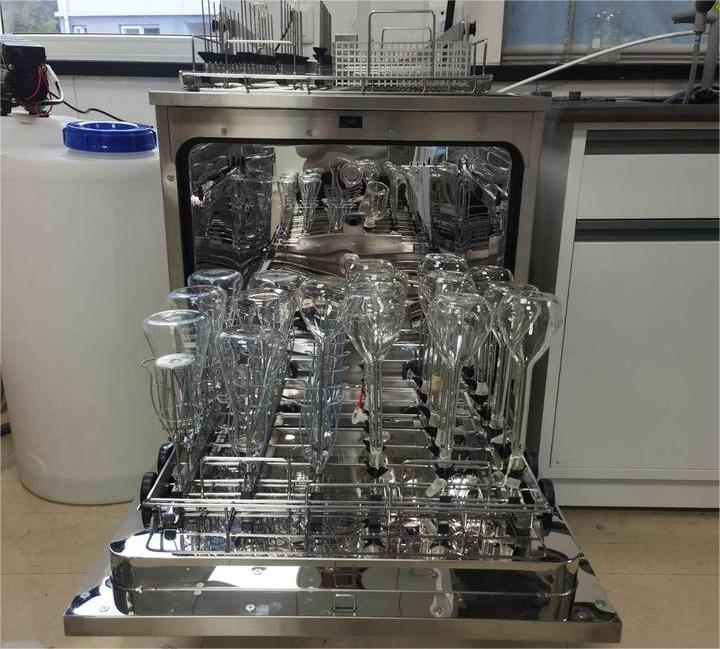
High-Pressure 360° Spray Vectors: Equipped with rotating spray arms and specialized injection spindle racks, high-pressure water streams hit internal vessel walls at precise angles, using fluid dynamics to shear off bound contaminants.
-
Thermal and Chemical Synergy: * Main Wash Phase: Water is heated up to 60℃~90℃. High temperatures rapidly denature, loosen, and saponify stubborn fats and proteins.
-
Alkaline Cleaners: Break down organic matrices, oils, and culture media.
-
Acidic Neutralizers: Dissolve inorganic mineral scale and completely neutralize lingering alkaline detergent carryover.
-
-
Ultrasonic Assistance (Optional): Employs micro-cavitation to implode tiny bubbles at a microscopic level, blasting solid particulates out of inaccessible microscopic fissures.
3. Standardization and Ultra-Low Residue Performance
Pure Water Rinsing and Spot-Free Drying
Hand washing typically relies on tap water, which contains high concentrations of calcium and magnesium ions that leave white mineral spots upon evaporation.
Automatic washers execute 3 to 5 deep rinse cycles using high-purity Deionized (DI) or Purified Water. Following rinsing, integrated HEPA-filtered hot-air drying systems dry the glassware inside a sealed chamber, eliminating ambient re-contamination and water spots.
Reproducible Process Control
Manual washing is inherently variable—technicians may rush when busy or use inconsistent amounts of detergent. Automatic washers rely on Programmable Logic Controllers (PLC) to ensure:
-
Precise volumetric water intake and thermal management.
-
Automated, milliliter-exact detergent dosing via peristaltic pumps.
-
Strict adherence to pre-validated Standard Operating Procedures (SOPs).
Reduced ATP Bioluminescence and Bio-Contamination Risk
In ATP bioluminescence tests, hand-washed Petri dishes often yield values in the hundreds of Relative Light Units (RLU). In contrast, automated washer cycles consistently reduce residue levels to below 50 RLU, meeting strict clinical and trace-analysis requirements. Furthermore, sealed processing prevents human skin flakes, oils, and airborne microbes from touching the glassware interior.
4. Head-to-Head Comparison: Manual vs. Automated Washing
| Feature | Manual Washing | Automatic Glassware Washer |
| Cleanliness Standard | Visually clean (prone to microscopic films/water spots) | Trace-level purity (suitable for HPLC, ICP-MS, & Cell Culture) |
| Consistency | Low (varies by technician, fatigue, and time) | High (PLC-controlled, 100% reproducible and auditable) |
| Complex Geometries | Poor (struggles with narrow necks, pipettes, and threads) | Superior (direct injection racks spray directly inside vessels) |
| Personnel Safety | High risk of chemical contact and glass lacerations | Fully enclosed, preventing direct exposure to hazards |
| Drying & Re-contamination | Ambient air drying leaves mineral spots and dust | HEPA-filtered hot-air drying; spot-free and sterile |
Conclusion
An automatic laboratory glassware washer is not just a substitute for manual labor—it is a critical upgrade to a laboratory’s Quality Control (QC) framework.
While manual washing may suffice for basic, non-sensitive chemistry, automated systems are indispensable for cell culture, molecular biology, and trace analysis. When weighed against the high cost of failed experiments, corrupted data, and wasted reagents, investing in automated washing technology delivers reliable, reproducible scientific results.
Post time: Aug-14-2026