
During routine laboratory testing and chemical synthesis, viscous organic residues frequently solidify on the inner walls of evaporating dishes and narrow-necked Erlenmeyer flasks. Managing these stubborn deposits through traditional manual washing presents distinct operational pain points.
Hard-bristled brushes can scratch ceramic glazes and wear away critical glass graduation markings. Furthermore, complex geometries, such as the curved bases and narrow necks of flasks, remain inaccessible—conventional soaking, manual rinsing, and ultrasonic baths often fail to eliminate baked-on impurities. This manual process consumes substantial labor hours, while residual micro-impurities risk compromising the accuracy of subsequent experimental data, ultimately slowing down the overall productivity of the laboratory.
To address these challenges, Hangzhou Xipingzhe Instruments Technology Co., Ltd. (XPZ) recently completed the successful installation and delivery of an automatic laboratory glassware washer at a research facility in Wuhan, proving that automated technology can redefine contamination control.
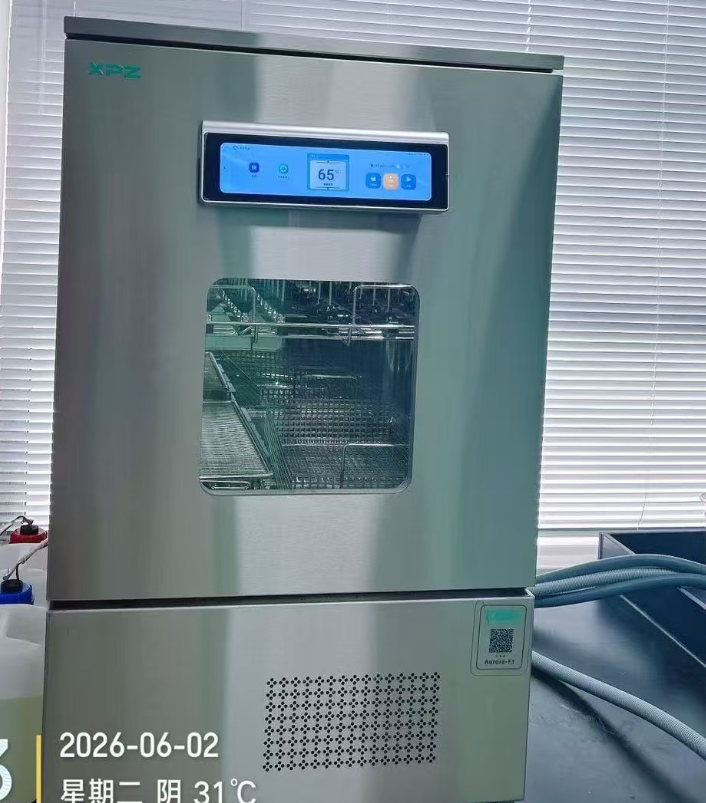
Aurora-F3
1. The XPZ Solution: A Standardized Intelligent Cleaning Protocol
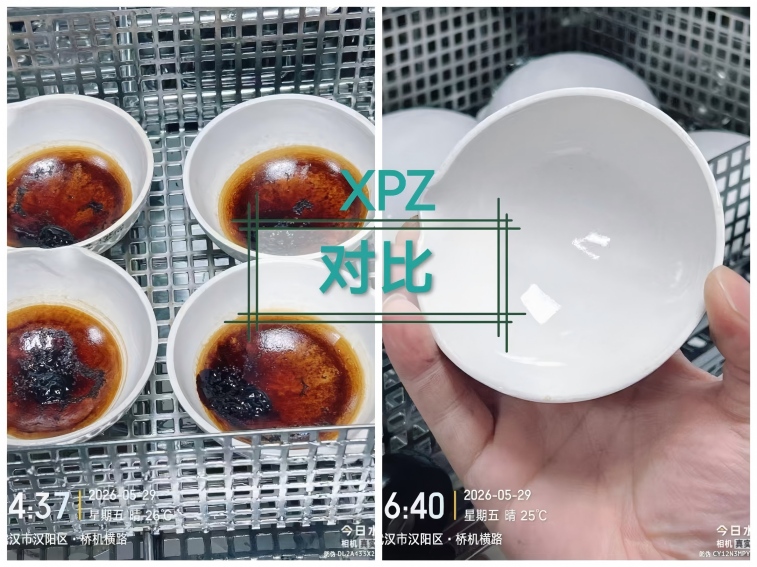
To demonstrate the machine’s capabilities under authentic working conditions, XPZ technicians conducted a live, on-site validation test using heavily contaminated vessels covered in dense, solidified organic matter. The automated system deployed a multi-phase configuration to ensure thorough decontamination:
-
High-Temperature Alkaline Main Wash: This phase fully saponifies and breaks down hardened, cross-linked organic matter adhered to the substrate surfaces.
-
360° Spray Arm Coverage: Utilizing an advanced tri-arm spray mechanism, the system drives high-pressure fluid vectors into every structural corner and blind spot of the glassware.
-
Pure Water Rinsing & Thermal Drying: The cycle concludes with a three-stage pure water rinse followed by integrated, constant-temperature hot air drying, allowing diverse categories of vessels to be processed simultaneously in a single batch.
2. Proven Results: GMP-Compliant Material Purity
The visual contrast before and after the automated cycle was definitive. Evaporating dishes originally caked with dark, hardened organic residues emerged with a pristine, brilliant white finish—completely free of stains and physical micro-scratches.
Similarly, the narrow-necked Erlenmeyer flasks regained complete optical clarity; graduation lines remained undamaged, and internal walls showed no signs of water spots, film, or organic trace elements. The resulting cleanliness successfully satisfied the rigorous standards required for GMP-compliant laboratory environments.
3. Versatility and Data Integration for Modern Research
The XPZ automatic washer features a highly adaptable core architecture that accommodates an extensive variety of laboratory containers, including evaporating dishes, flasks, beakers, and volumetric glassware. The system supports customized programming to match varying soil loads and includes an integrated data-logging printer for real-time cycle parameter tracking, creating a secure audit trail for quality assurance. By operating completely unattended, the system eliminates repetitive manual labor and allows scientific personnel to dedicate their valuable time to core research and analytical tasks.
Conclusion As a high-tech enterprise deeply rooted in the field of intelligent laboratory cleaning, XPZ continuously verifies product under real-world client operating conditions. Leveraging self-developed cleaning algorithms and strong academic-industrial technical synergy, XPZ provides highly efficient, compliant, and stable turnkey cleaning solutions for pharmaceuticals, third-party testing laboratories, and higher education research centers worldwide—ensuring that scientists can focus fully on innovation.
Post time: Jul-03-2026